Radhika Prasad
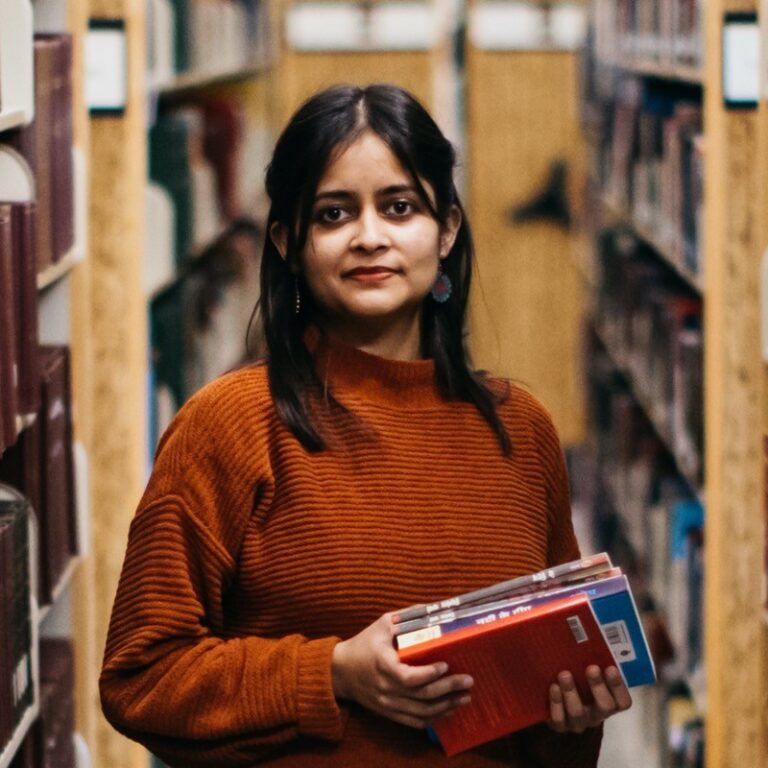
I’m a literary scholar, writer, and educator who thinks about how language is molded by literary cultures. My work on Hindi literary modernism questions the affiliation of languages with nation states and studies literature’s capacity to destabilize the same.
About Me
I received my Ph.D. in Literature from the University of California, Santa Cruz in 2025, specializing in South Asian Studies and Feminist Studies. My thought is animated by questions of translation, literary experiment, and the contradictions of nationalism. My doctoral dissertation, “Experiments with a National Language: A Study of Hindi Modernism,” analyzes the ways in which Hindi modernist fiction’s formal experiments undermined Hindi’s status as the official language of India.
Against the background of socio-political upheaval in the wake of Indian independence in 1947, mid-twentieth century Hindi literature grappled with two problems: Hindi’s claim to supremacy over other languages, and the difficulty of representing a new nation. While Hindi modernist fiction held an evasive attitude towards Indian nationhood, I argue that the history that these texts refused to address directly came to reside in their formal experiments.
Teaching and Pedagogy
At UCSC, I have taught for 15 quarters, serving as a Teaching Assistant for a variety of upper and lower division classes in the Literature and Feminist Studies departments including Introduction to Shakespeare, Politics of Fashion, Reading Fiction, and Introduction to Feminist Studies. I have also had the opportunity to teach my own class on South Asian Literature, which included curating a syllabus, developing assignments, and preparing lectures. My teaching interests speak to questions of language politics, translation, race, feminism, and nationalism. I am capable of teaching a wide range of courses on translation studies, postcolonial literature, and modernism and am also excited to develop classes on reading gender and sexuality in literature, and 20th century world literature. Teaching honors and mixed major classes for both Literature and Feminist Studies departments has given me multiple opportunities to engage materials beyond the US American context, and I have enjoyed helping students approach culturally, linguistically, and formally unfamiliar texts with curiosity and enthusiasm.
As both a student and an educator, I have learned that a sense of community and pleasure in learning are critical to the success of the classroom. In order to facilitate these, I orient my teaching strategies towards making the classroom a collaborative space in which each student can see themself as an active contributor to the building of shared knowledge.